Roof Repair in Unionville, PA: Slate, Shingle, Flat and Emergency Leak Repair
A leaking roof in Unionville is rarely just a roof problem. It is a 19th century stone farmhouse with original slate, a barn with a rusting metal roof, or a newer home off Route 82 that lost shingles in the last windstorm. We repair and replace roofs across Unionville, East Marlborough Township and the surrounding Brandywine Valley, and we start every job by finding the actual cause of the leak, not just the wet spot.
- Slate, cedar, asphalt shingle, metal and flat roof repair
- Written estimates with photos of every problem we find
- Homes, garages, barns and small commercial buildings
- Serving 19375, 19348, 19382, 19366, 19317 and 19320
Water coming in right now? Call and tell us if a tree or limb is on the roof. We will walk you through the next hour.
Call (610) 817-4457Roof repair services in Unionville at a glance
We fix roof leaks, replace broken slates and shingles, rebuild flashing around stone chimneys, repair rotted soffit and fascia, patch and recover flat roofs, and replace roofs that are past saving. When a repair makes sense, we repair. When it does not, we show you the evidence and explain why.
Roof leak repair
A ceiling stain tells you water got in. It does not tell you where. Water can run along a rafter or the top of a plaster ceiling for several feet before it shows. We trace the leak from the attic side and the roof side, then fix the source: a cracked pipe boot, a lifted shingle, a failed valley, a slipped slate or open flashing at a chimney or dormer.
Emergency roof repair and tarping
When a limb comes through the roof or wind strips a section bare, the first job is to stop more water from getting in. We tarp or temporarily seal the opening, photograph the damage for your insurer, and schedule the permanent repair once the weather allows. Tell us on the phone whether water is actively coming in. That decides how fast we need to move.
Slate roof repair
Slate is the roof most often replaced when it did not need to be. What usually fails first are the nails, the flashing and the occasional cracked or slipped slate. We replace individual slates with matched slate, use slate hooks or copper nail-and-bib repairs where they fit, and reflash chimneys and valleys in copper so the repair lasts as long as the stone.
Asphalt shingle repair
Wind lifts and creases shingles along ridges, rakes and the windward slope. We replace damaged shingles, reseal tabs, repair ridge caps and fix exposed nail heads. If your shingles are brittle and the granules are gone, we will say so before you spend money patching a roof that is near the end.
Flat and low-slope roof repair
Porch roofs, rear additions, garages and small commercial buildings often have EPDM rubber, TPO or modified bitumen roofs. Ponding water, open seams and failed edge details cause most leaks. We patch, reseam, recover or replace depending on what the membrane and the deck underneath can still handle.
Soffit and fascia repair
Rotted fascia boards, sagging soffits and gaps that let squirrels and birds into the attic usually trace back to an overflowing gutter or a missing drip edge. We replace the rotted wood, close the openings, and fix the water problem that caused the rot so it does not come back in two winters.
Garage, barn and outbuilding roofs
This is horse country. Detached garages, carriage houses, bank barns, run-in sheds and equipment buildings all need roofs, and they often get ignored until the leak reaches feed, tack or a car. We repair and replace metal, shingle and membrane roofs on outbuildings, including garage roof replacement.
Commercial roof repair
We repair low-slope and steep-slope roofs on small commercial buildings, offices, churches and farm businesses in southern Chester County: leak tracing, membrane repair, flashing at rooftop units and drains, and planned replacement when repairs stop making sense.
Roof replacement
When the roof is truly done, we replace it: tear-off, decking inspection and replacement, ice and water barrier at eaves and valleys, new flashing, proper ventilation and the material that fits your house. Slate stays slate on historic homes when the owner wants it.
Small roof repairs
One cracked pipe boot, a few wind-blown shingles, a loose ridge cap or a single slipped slate. Small jobs matter because small leaks become rotted decking. We take them seriously and price them plainly.
Roof repair estimates
Every estimate is written and comes with photos of what we found. You will see the damaged areas, the likely cause, the repair we recommend, and any alternatives, so you can decide with the facts in front of you.
Unionville 19375 key facts for homeowners
Unionville is small, old and spread out, and all three facts shape how roofs here age and how repairs get done.
| Fact | Detail |
|---|---|
| Where it is | Unincorporated village and census-designated place in East Marlborough Township, southern Chester County |
| ZIP code | 19375 for the village post office; many nearby Unionville addresses use Kennett Square 19348 or West Chester 19382 |
| Size | 577 residents in the 2020 Census, on about 0.86 square miles |
| Original name | Jacksonville, after the Jackson family who lived nearby |
| Historic district | Unionville Village Historic District, listed on the National Register in 1979, 69 contributing buildings on about 120 acres |
| Oldest dated building | Cross Keys Inn, 1751 |
| Age of village homes | Most existing homes date from 1820 to 1880 |
| Main roads | PA 82 (Unionville Road and Doe Run Road), PA 162 (Embreeville Road), PA 842 (Unionville Wawaset Road), PA 926 (Street Road), U.S. 1 to the south |
| Township office | East Marlborough Township, 721 Unionville Road, Kennett Square, PA 19348, 610-444-0725 |
| Electric utility | PECO Energy |
| School district | Unionville-Chadds Ford School District |
Sources: Unionville (Wikipedia, U.S. Census), Unionville Village Historic District, ChesterCounty.com, PA Office of Open Records.
What these facts mean for your roof
- Old housing stock means old roofing systems. A house built between 1820 and 1880 may have had three or four roofs in its life. The current one may sit on original plank sheathing, over framing that has settled, under chimneys that have been repointed many times. Repairs on these homes need care, not speed.
- A rural, wooded setting means tree damage. Large oaks, tulip poplars and sycamores along roads like Doe Run and Wawaset drop limbs in wind and ice. The 2026 storm outages PECO reported in Chester County were blamed on tree limbs, the same limbs that land on roofs.
- Spread-out properties mean outbuildings. Garages, barns and carriage houses often have roofs that were never built to the house’s standard. They need their own plan.
- A historic district means character matters. Matching slate color, keeping copper where copper was, and avoiding a patch that shouts from the road are part of doing the job right.
The roofs you will see around Unionville
Unionville’s roofs tell the area’s story in layers: 18th and 19th century stone and brick in the village, farmhouses and bank barns on the surrounding land, and newer homes built on former fields. Each type fails in its own way.
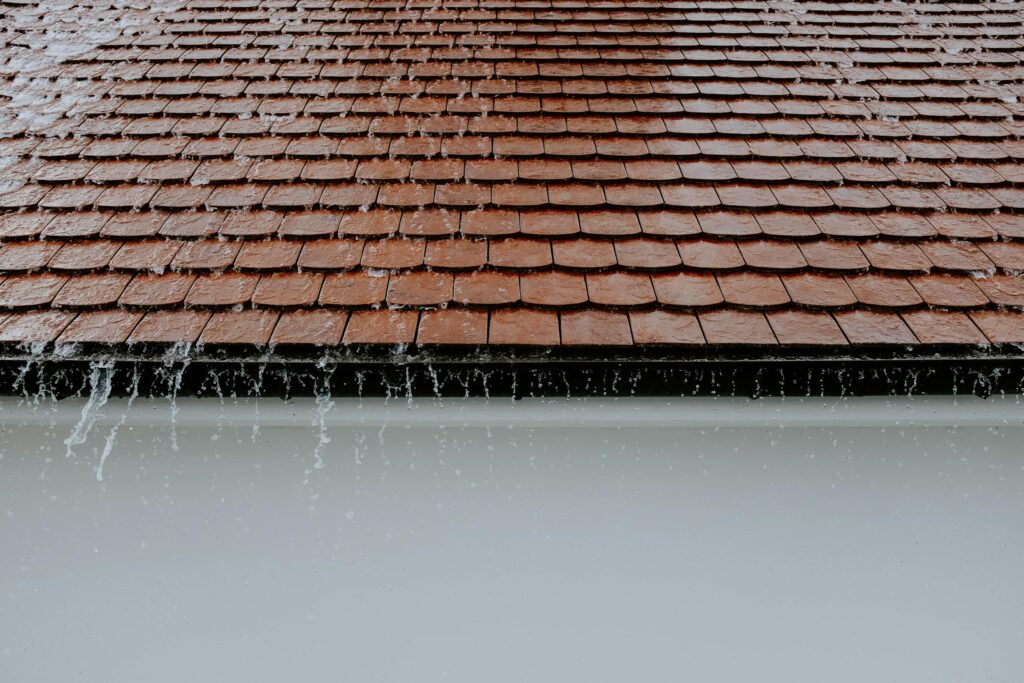
Historic village homes: slate, standing seam and copper
The Unionville Village Historic District includes brick, stone and frame houses, the earliest from about 1750, along with the Unionville Academy (1834), the Union Hotel (1834), the Cross Keys Inn (1751), Unionville Hall (1849 to 1850) and the Unionville Saddle Shop (1887). Homes of this age in southeastern Pennsylvania commonly carry slate, standing seam metal, or later asphalt shingles laid over original sheathing.
What goes wrong:
- Nail fatigue on slate. The stone outlives the nails. Slates slip out of place one at a time, leaving dark gaps you can see from the road.
- Failed chimney flashing. Stone and brick chimneys move, mortar erodes, and old lead or tar flashing cracks. This is the most common leak source we find on historic homes.
- Patchwork from past repairs. Roofing tar smeared over slate, mismatched pieces and face-nailed slates trap water and make the next repair harder.
- Built-in gutters. When the metal lining of a gutter built into the cornice fails, water goes straight into the wall and the soffit.
Our approach: repair before replace, match the slate, use copper where the original detail used copper, and never tar over a slate roof.
Farmhouses and estates: big roofs, many valleys
Larger properties in East Marlborough, West Marlborough, Newlin and Pocopson townships often have additions built over many decades. Every addition creates a new valley, a new wall-to-roof joint and a new place for water to get in. These roofs need someone who looks at the whole system, not just the stained room.
Bank barns, carriage houses and equestrian buildings
Unionville sits in active horse country. Plantation Field, home to international eventing off Route 82, sits beside the kennels of the Cheshire Foxhounds, and Penn Vet’s New Bolton Center is a few miles away. Barns, stables, run-in sheds and arenas need roofs that shed water over hay, horses and equipment. We see rusted or loose fasteners on exposed-fastener metal, wind-lifted panels along ridges and eaves, condensation dripping from uninsulated metal, and worn-out roll roofing on lean-tos and sheds.
Newer homes: architectural shingles and complex rooflines
Homes built from the 1980s onward usually have asphalt shingle roofs with gables, dormers and skylights. The weak points are the details: pipe boots that crack after 10 to 15 years of sun, step flashing behind siding, and skylight curbs.
Porches, sunrooms and additions: flat and low-slope roofs
A shallow porch roof, a rear sunroom or a flat-roofed addition is where we find slow, hidden leaks. Water ponds, seams open, and the leak shows up inside a wall months later.
Quick guide: roof types and what to check
| Roof type | Where you see it locally | First thing to check |
|---|---|---|
| Natural slate | Historic village homes, older farmhouses | Slipped or missing slates, chimney and valley flashing |
| Standing seam or copper | Historic porches, bays, some main roofs | Open seams, worn coating, flashing at walls |
| Cedar shake | Some older and custom homes | Splitting, moss, curling, rot at the eaves |
| Architectural asphalt | Most homes built since the 1980s | Pipe boots, lifted shingles on the windward side, granule loss |
| Exposed-fastener metal | Barns, sheds, equestrian buildings | Rusted screws, worn washers, wind-lifted panels |
| EPDM, TPO or modified bitumen | Porches, additions, garages, commercial | Ponding, open seams, edge and wall flashing |
What Chester County weather does to Unionville roofs
Wind and falling trees cause more emergency roof calls around Unionville than anything else, and 2026 has already shown why. PECO’s outage reports to the Pennsylvania Public Utility Commission show three storms this year that cut power to thousands of Chester County customers, each blamed on tree limbs brought down by wind.
| Storm date | Chester County customers without power | Cause PECO reported |
|---|---|---|
| May 20, 2026 | 7,259 | Heavy winds and rain brought down tree limbs (filing) |
| March 16, 2026 | 29,553 | Heavy winds brought down tree limbs (filing) |
| February 22, 2026 | 5,765 | Heavy winds and snow brought down tree limbs (filing) |
On July 28, 2026, the National Weather Service in Mount Holly issued a radar-indicated tornado warning for south central Chester County, warning of damage to roofs, windows and vehicles. Severe thunderstorm warnings this year for southwestern Chester County also called for 60 mph gusts and quarter-size hail. The roof over a Unionville home takes real weather every year, and the damage is often invisible from the ground.
Wind uplift
Gusts get under shingle edges along rakes, ridges and the windward slope. A shingle can lift, crease and settle back looking normal while its seal is broken. The next wind-driven rain gets under it.
Falling limbs and trees
Mature trees are part of what makes this area beautiful. They are also why a calm afternoon can end with a hole in the roof. Even a limb that bounces off can crack slate, dent metal or break shingle seals.
Ice dams
Heat escaping from the house melts snow on the upper roof. The water refreezes at the colder eaves and backs up under shingles and slates into walls and ceilings. Older homes with little attic insulation get them most.
Freeze and thaw cycles
Water in cracks in mortar, sealant and flashing expands when it freezes. Over a winter, this opens chimney joints, pushes flashing loose and widens small cracks in old slate.
Heavy and wind-driven rain
Summer thunderstorms drop a lot of water fast. Clogged gutters overflow behind the fascia and valleys get overwhelmed. Many new leaks after a big storm are old weak spots that finally got enough water to show.
Shade, moss and debris
North-facing slopes under heavy tree cover stay damp. Moss holds moisture against shingles and shakes. Leaves pack valleys and gutters, and squirrels and birds go after weak soffits and vents.
What you can check from the ground after a storm
- Shingles, slates or ridge caps in the yard or gutters
- Dark gaps or lighter patches on the roof where material is missing
- Bent or lifted metal panels and flashing at chimneys and walls
- Limbs resting on the roof or hanging over it
- Water stains on ceilings under valleys, chimneys and skylights
- Damp insulation or daylight visible from the attic
Stay off the roof
Do not climb onto a wet, icy or storm-damaged roof. Slate and metal are slippery, and a damaged roof can hide weakened decking. Photograph what you can from the ground and call us at (610) 817-4457.
Weather sources: NWS alerts via Weather Underground, Forth.
Should you repair or replace your roof?
Repair when the damage is limited to one area and the rest of the roof is sound. Replace when problems show up in several unconnected places, the material itself has worn out, or water has already damaged the decking across large areas. Most roofs we look at can be repaired, and we will tell you plainly when yours cannot.
Signs a repair is the right call
- The leak traces to one source: a chimney, a vent, a valley or a skylight
- A storm damaged one section and the rest of the roof is in good shape
- A slate roof has a handful of slipped or broken slates but the stone is still hard and rings when tapped
- The shingles still hold their granules and bend without cracking
- The decking under the damaged area is firm
Signs replacement is coming
- Leaks in several rooms that trace to different parts of the roof
- Shingles that curl, crack when bent or have lost most of their granules
- Widespread soft or rotted decking
- Slate that flakes, crumbles or sounds dull when tapped
- You pay for a repair every year and the roof is past its expected life
How long roofs last here
Lifespan depends on material, installation, ventilation and how much shade and weather a roof takes. As a general guide:
- Architectural asphalt shingles: often 20 to 30 years
- Cedar shake: often 20 to 30 years, less under heavy shade
- Standing seam metal: often 40 years or more
- Hard natural slate: commonly 75 years or more; the flashing and nails usually fail first
What roof repair costs in 2026
We price every job from what we find on your roof, in writing. National 2026 benchmarks give a useful starting point:
| Repair type | National 2026 range |
|---|---|
| Typical roof repair | $400 to $1,900, average about $1,150 |
| Roof leak repair | $350 to $1,500 |
| Slate roof repair | $700 to $3,000 |
| Flat roof repair | $300 to $1,100 |
| Flashing repair | $150 to $1,000 |
| Soffit and fascia repair | $600 to $6,000 |
| Major roof damage repair | $2,000 to $6,000 |
Sources: Fixr, HomeAdvisor. These are national figures, not quotes.
What moves the price on a Unionville roof
Material. Slate, copper and cedar take more skill and cost more per piece than asphalt.
Pitch and height. Steep, tall roofs need more safety equipment and time.
Access. Long driveways, landscaping, outbuildings and tight lots change how materials reach the roof.
Matching. Finding slate or copper that matches an old roof takes time.
Hidden damage. Rotted decking or framing only shows once roofing comes off. In This Old House’s 2026 survey, nearly 28% of Pennsylvania homeowners said hidden damage raised their final replacement cost (source). Our estimates explain how any decking replacement will be priced before work starts.
Emergency roof leak? Do these five things first
If water is coming in right now, your job is to protect people and belongings. Ours is to stop the water at the roof.
- Stay safe. If water is near light fixtures, outlets or the electrical panel, switch off power to that area at the breaker if you can do it without standing in water. Keep everyone out of a room with a sagging ceiling.
- Catch and direct the water. Buckets and towels under drips. If water is pooling in a ceiling bulge, a small hole at the lowest point over a bucket can release it in a controlled way.
- Move what matters. Electronics, documents, rugs and furniture out of the wet area.
- Document everything. Photos and video of the ceiling, the attic if safe, debris in the yard and the roof from the ground, with the date and time.
- Call (610) 817-4457. Tell us whether water is actively coming in, whether a tree or limb is on the roof, and the address. We arrange temporary protection and schedule the permanent repair.
If a tree is touching power lines, stay away and report it to PECO before anyone works on the roof.
Emergency, or can it wait a day?
Call right away when water is coming through a ceiling or light fixture, a tree or large limb is on the roof, you can see a hole or exposed decking, or leaks are showing up in more than one room. An old dry stain, a few granules in the gutter, or a single missing shingle with no water inside can usually wait for a scheduled inspection.
Storm damage and homeowners insurance in Pennsylvania
Most homeowners policies cover sudden damage from events like wind, hail and falling trees. They generally do not cover wear and tear, age or poor maintenance. Your policy wording decides what is covered, so read it or ask your agent.
- We document damage with dated photos, measurements and a written description
- We separate storm damage from pre-existing wear, so the adjuster sees an honest picture
- We can meet the adjuster on site if you want us there
- We give you a written repair estimate you can submit
What we will not do: promise a free roof, offer to cover your deductible, or pressure you to sign anything before you have read it.
A warning about storm chasers
After big storms, out-of-area crews knock on doors across Chester County. Before you hire anyone, ask for their Pennsylvania Home Improvement Contractor registration number, ask for proof of insurance, and read the contract.
Permits, contractor rules and who to call in Unionville
Pennsylvania does not license roofers the way some states do. It requires home improvement contractors to register with the Attorney General and sets firm rules for contracts and deposits. Knowing those rules is the fastest way to spot a contractor you should not hire.
What Pennsylvania’s Home Improvement Consumer Protection Act requires
- Registration. Anyone who runs a home improvement business or performs home improvements in Pennsylvania must register with the Office of Attorney General. Registrations last two years.
- Registration number on the contract. The contractor’s registration number must appear on the contract.
- Written contracts. Home improvement contracts over $500 must be in writing and include the Bureau of Consumer Protection’s phone number, 1-888-520-6680.
- Your right to cancel. The contract must tell you that you can rescind it. Pennsylvania courts have enforced the three business day rescission window against contractors who ignored it.
- A cap on deposits. On contracts over $1,000, a contractor may not take a deposit above one-third of the price, or one-third plus the cost of special order materials.
- No payment before signing. A contractor cannot demand or accept payment before the contract is signed.
Sources: HICPA information sheet, Commonwealth Court opinion.
Do you need a permit to replace a roof in East Marlborough Township?
Under Pennsylvania’s Uniform Construction Code, residential reroofing has generally not required a state building permit, but the work still has to comply with the code and the manufacturer’s installation rules (PA Code Alliance). Replacing structural parts such as rafters, studs or headers does need a permit, and some municipalities set their own roofing rules. Before a replacement, we confirm requirements with the township for your address.
A note on the historic district
The Unionville Village Historic District is listed on the National Register of Historic Places. A National Register listing by itself usually does not restrict what a private owner does with private money, but local ordinances, deed restrictions or conservation easements can. Check before changing roofing material, color or profile. We are glad to help you gather photos and product samples for that conversation.
Who to call
| Need | Who | Contact |
|---|---|---|
| Active roof leak or storm damage | Unionville PA Roofer | (610) 817-4457 |
| Downed power lines or a tree on lines | PECO | Report through PECO and stay clear of the lines |
| Permits and zoning, Unionville area | East Marlborough Township, 721 Unionville Road | 610-444-0725 |
| Permits and zoning, west of Unionville | West Marlborough Township, 1300 Doe Run Road | (610) 383-5986 |
| Complaint about a contractor | PA Bureau of Consumer Protection | 1-888-520-6680 |
| Insurance claim | Your insurance agent or carrier | The number on your policy |
Where we work: Unionville and nearby ZIP codes
We repair roofs in Unionville and the villages, townships and boroughs around it in southern Chester County. Postal addresses here can be confusing: a home a mile from the Unionville crossroads might carry a Kennett Square, West Chester or Coatesville mailing address. If you are near Unionville and not sure whether we cover your road, call and ask.
| ZIP | Post office | Areas it commonly covers near Unionville |
|---|---|---|
| 19375 | Unionville | The village and nearby village addresses |
| 19348 | Kennett Square | Much of East Marlborough and Kennett townships, including many homes on Unionville, Doe Run and Wawaset roads |
| 19382 | West Chester | Homes north and east of Unionville toward Marshallton, Pocopson and Birmingham |
| 19366 | Pocopson | Pocopson Township addresses |
| 19317 | Chadds Ford | Chadds Ford and Pennsbury areas along the Brandywine |
| 19320 | Coatesville | West Marlborough, Newlin and areas west toward Embreeville and Doe Run |
Townships and communities
- East Marlborough Township: Unionville village, the Longwood area, the Route 82 and Route 926 corridors
- West Marlborough Township: Doe Run and the horse country west of Unionville
- Newlin Township: Marlborough village and the West Branch of the Brandywine
- Pocopson Township, Kennett Township and Kennett Square, Pennsbury Township and Chadds Ford, and West Chester
Drive times from the Unionville crossroads
| Destination | Approximate distance or time | Main route |
|---|---|---|
| Penn Vet New Bolton Center | About 3.3 miles | Local roads to PA 926 |
| Kennett Square borough | About 4 miles | PA 82 south |
| West Chester borough | About 9 miles | PA 162 or PA 842 |
| Wilmington, DE | About 35 minutes | PA 82 to U.S. 1 or PA 52 |
| Philadelphia International Airport | About 35 to 45 minutes | U.S. 1 or U.S. 322 |
Typical distances, not guarantees; times change with traffic, weather and school hours. PA 162’s 9.2 mile run to West Chester per AARoads; other figures from local listing descriptions.
Little-known Unionville history, and what it means for your roof
Most people know Unionville for horses, open fields and good schools. Its buildings carry a longer story, and that story explains why so many roofs here need a careful hand.
What this history means for roof work
- Expect the unexpected under old roofs. Plank sheathing, past fire damage, old chimney flues and earlier roof lines often show up once roofing comes off. We price that possibility honestly up front.
- Respect the original materials. Slate, copper, standing seam and wood details are part of what makes these homes valuable. A careless repair can cost more in lost character than it saves.
- Chimneys deserve special attention. Stone and brick chimneys on 19th century homes are the most common leak source we find. Step and counter flashing cut into the mortar joints, not glued to the face, is the fix that lasts.
1729: Marlborough splits in two
East Marlborough and West Marlborough townships were carved out of the larger Marlborough Township.
1751: The Cross Keys Inn
The oldest dated building in the historic district. Buildings this old have been reroofed many times, and each roofer left something behind.
Early 1800s: Jacksonville becomes Unionville
The village was first named for the Jackson family who lived nearby.
1834: The Unionville Academy
It taught surveying, navigation, astronomy, French, German and Latin. Among its students was J. Smith Futhey, co-author of the History of Chester County.
1820 to 1880: The village takes shape
Most homes standing today were built in these years, along with the Grange Hall (1845), Unionville Hall (1849 to 1850) and the Saddle Shop (1887).
1979: National Register listing
The 120 acre district along PA 162 and PA 82 was listed as an example of a 19th century rural village.
2001: Plantation Field
The first horse trials ran on land mostly used for grazing cattle. It now hosts trials in April, May, June and September.
Life around Unionville
Many Unionville homeowners plan to stay for years, and that changes how they think about a roof. A homeowner planning to stay 20 more years wants the repair that lasts, not the cheapest patch.
Landmarks and open space
- Longwood Gardens, inside East Marlborough Township, a short drive south of the village
- Plantation Field, international eventing off Route 82 beside the Cheshire Foxhounds kennels
- Penn Vet New Bolton Center, the University of Pennsylvania’s large animal hospital, about 3.3 miles away
- Unionville Community Park, trails, open space and a playground on West Doe Run Road
- The Brandywine Valley, with Chadds Ford and the Brandywine River Museum of Art to the east
- Kennett Square, about 4 miles south, known as the Mushroom Capital of the World
Schools
Unionville is in the Unionville-Chadds Ford School District. Unionville Elementary, Charles F. Patton Middle School and Unionville High School all sit within a couple of miles of the village. We plan loud tear-off work around early bus and drop-off traffic on village roads when we can.
Conservation and trees
Much of the land around Unionville is protected open space, and the tree canopy is a big part of its character. We work around mature trees, landscaping and stone walls with ground protection and careful material staging.
The roofing year here
- Spring: horse trial season, and the windstorms that tend to arrive with it
- Summer: thunderstorms, heavy rain and the occasional tornado warning
- Fall: leaves in every valley and gutter on wooded lots, and the best window for planned roof work
- Winter: snow, ice dams and freeze and thaw cycles that open up weak flashing
How a roof repair works with us
You should know what happens before anyone sets a ladder against your house.
- You call or send us the details. What you are seeing, the address, and whether water is coming in now. Photos help.
- We inspect inside and out. The attic or ceiling below the leak, then the roof itself where it is safe. We photograph every problem we find, not just the one you called about.
- You get a written estimate with photos. What is wrong, what caused it, what we recommend, any alternatives, and how hidden damage such as rotted decking will be handled.
- You decide, with no pressure. Pennsylvania gives you a rescission period on home improvement contracts, and no payment is due before you sign.
- We do the work and protect your property. Ground tarps over landscaping, magnetic sweeps for nails, and care around stone walls, gardens and outbuildings.
- We show you the finished repair. Before and after photos, plus a walk-through if you are home.
What we promise every Unionville homeowner
- Find the cause, not just the stain. We do not sell a repair until we can show you where the water is getting in.
- Repair before replace. If your roof has life left, we will tell you, even when a replacement would be a bigger job for us.
- Respect the house. Matching materials, careful flashing and clean work on historic and newer homes alike.
- Straight answers in writing. Price and scope on paper before work starts.
Roof repair questions Unionville homeowners ask us
Straight answers to the questions we hear most. Still not sure? Call (610) 817-4457.
How much does roof repair cost in Unionville, PA?
Most roof repairs nationally cost $400 to $1,900, with an average around $1,150 in 2026, according to Fixr. Slate repairs typically run $700 to $3,000. Steep, tall or historic roofs around Unionville can cost more because they take more time and care. We give you a written price after inspecting your roof.
Can a slate roof be repaired instead of replaced?
Yes, in most cases. Hard slate commonly lasts 75 years or more, and the nails and flashing usually fail long before the stone. Replacing slipped or broken slates and reflashing chimneys and valleys can add decades of life. Replacement makes sense only when the slate itself is flaking, soft or failing across the roof.
Do I need a permit to replace my roof in East Marlborough Township?
Pennsylvania’s Uniform Construction Code has generally not required a state building permit for residential reroofing, but the work must still meet code. Structural repairs to rafters or framing do need a permit, and local rules can differ. Call East Marlborough Township at 610-444-0725 to confirm for your address. We check before every replacement.
How do I check if a roofer is registered in Pennsylvania?
Ask for the contractor’s Home Improvement Contractor (HIC) registration number. Pennsylvania requires anyone performing home improvements to register with the Office of Attorney General, and the number belongs on the contract. You can verify it through the Attorney General’s contractor registration lookup.
How much of a deposit can a roofer ask for in Pennsylvania?
On home improvement contracts over $1,000, Pennsylvania law caps the deposit at one-third of the contract price, or one-third plus the cost of special order materials. A contractor also cannot take any payment before the contract is signed. A request for a larger deposit is a red flag.
What should I do if my roof leaks during a storm?
Stay out of rooms with sagging ceilings, turn off power to wet areas if it is safe, catch the water in buckets, move valuables and photograph everything. Then call a roofer for temporary protection. Do not climb onto a wet or damaged roof.
Will my homeowners insurance pay for roof repair?
Most policies cover sudden damage from wind, hail and falling trees, but not wear and tear or age. Coverage depends on your policy wording and deductible. We document storm damage with dated photos and a written report you can send to your insurer.
Is a water stain on my ceiling always a roof leak?
No. Plumbing leaks, bathroom exhaust fans venting into the attic, condensation and ice dams can all cause ceiling stains. A stain that appears or grows after rain usually points to the roof. One that appears regardless of weather often points to plumbing or condensation.
How long does a roof last in Chester County?
Architectural asphalt shingles often last 20 to 30 years, cedar shake about 20 to 30, standing seam metal 40 or more, and hard natural slate 75 years or longer. Shade, ventilation and installation quality can shorten or extend those numbers.
What causes ice dams and how do you prevent them?
Ice dams form when heat from the house melts snow on the upper roof and the water refreezes at the colder eaves. Better attic insulation and ventilation reduce them. On a replacement, ice and water barrier at the eaves and valleys keeps backed-up water out of the house.
Do you repair barn, garage and outbuilding roofs?
Yes. We repair and replace roofs on detached garages, carriage houses, bank barns, stables, run-in sheds and equipment buildings, including metal, shingle and membrane roofs.
Do you work on homes in the Unionville Village Historic District?
Yes. We repair slate, copper, standing seam and other traditional roofing with matching materials. National Register listing alone usually does not restrict private owners, but deed restrictions, easements or local rules may, so check before changing materials or appearance.
Do you repair flat roofs on porches and additions?
Yes. We repair EPDM, TPO and modified bitumen roofs on porches, sunrooms, additions, garages and small commercial buildings, including seams, ponding areas and wall flashing.
Which ZIP codes do you serve?
We serve Unionville 19375 and nearby addresses in Kennett Square 19348, West Chester 19382, Pocopson 19366, Chadds Ford 19317 and Coatesville 19320. Call to confirm your road.
What are your hours?
We answer Monday to Saturday, 8:00 am to 8:00 pm. We are closed on Sunday. Call (610) 817-4457.
How do I get a roof repair estimate?
Call or text (610) 817-4457 with your address and what you are seeing. After we inspect, you get a written estimate with photos of every problem we found, the likely cause, the repair we recommend and any alternatives.
Do you handle commercial roof repairs?
Yes. We repair low-slope and steep-slope roofs on small commercial buildings, offices, churches and farm businesses in southern Chester County.
Talk to a Unionville roofer today
Whether it is one slipped slate on a village home, a leak over the kitchen after the last windstorm, or a barn roof that finally gave up, the first step is the same: a straight look at what is actually wrong. Call or text, tell us what you are seeing, and we will tell you honestly what it needs.
Call (610) 817-4457 Text a photo of the damage
- Phone
- (610) 817-4457
- Address
- 850 Unionville Road, Kennett Square, PA 19348
- Hours
- Monday to Saturday, 8:00 am to 8:00 pm. Sunday closed.
- Service area
- Unionville, East Marlborough Township and nearby communities in 19375, 19348, 19382, 19366, 19317 and 19320
When you call, it helps to have
- The property address and the best number to reach you
- Your roof type if you know it: slate, shingle, metal, flat or not sure
- Whether water is coming in right now
- Where the stain or drip is, and when it started
- A few photos of the ceiling and of the roof from the ground